Ice maker
Sub-Zero Ice Maker Repair on Fleming Island
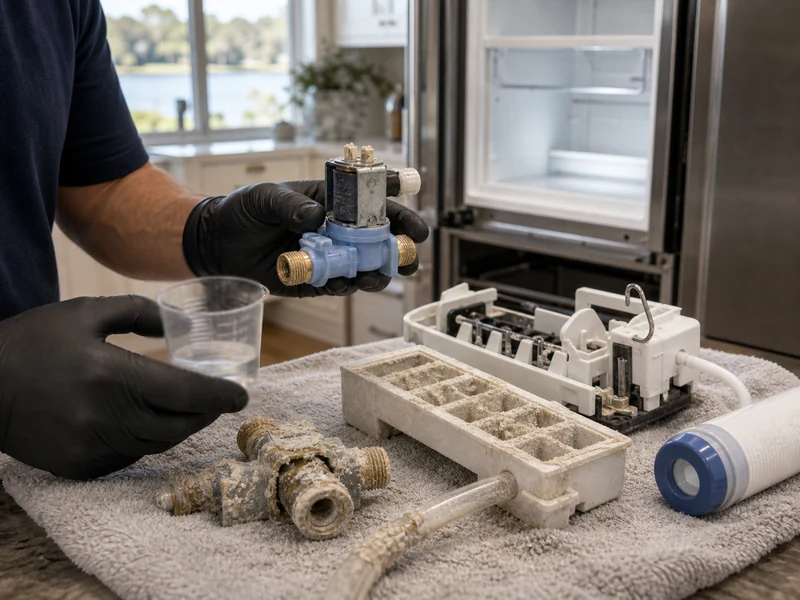
Weak cubes, a dead bin, or cloudy ice on Clay County water nearly always comes back to
one thing — scale in the fill path — long before the module itself is to blame.
Around Fleming Island, Pace Island, and Orange Park, most Sub-Zero® ice-maker calls
trace to hard-water scale choking the inlet valve and fill tube. Clay County water runs
hard, so production fades and cubes turn cloudy. Descaling, valve, and filter repairs
run $250 to $700, diagnosed before any part goes in.
For Sub-Zero repair across Fleming Island, Pace Island and the Orange Park riverfront, call (904) 892-7163 or Book online.
Sub-Zero Fleming Island · Fleming Island, FL 32003 · (904) 892-7163
· online booking available · Updated June 13, 2026
Up front
Why your ice maker quit, in plain terms
Who repairs Sub-Zero ice makers in Fleming Island?
Sub-Zero Fleming Island handles Sub-Zero ice-maker work across Fleming Island
32003, Pace Island, and Orange Park, with booking by phone at
(904) 892-7163 or through an external
online scheduling page. We are the shop that keeps Clay County on the route, not the map.
What is the first thing to check?
The water filter and the fill path. A spent filter and mineral scale account for the
bulk of weak-production and bad-taste complaints we see. Both are inexpensive fixes, and
ruling them out first keeps you from paying to swap a perfectly good ice module.
What does a typical repair run?
Descaling, a new filter, or a water inlet valve usually lands between $250 and $700,
diagnosed before any part is ordered. A full ice-maker module replacement sits at the
top of that range, and we only go there once the cheaper links test clean.
One call, one tech, straight answers.
Diagnosis
What is wrong with my Sub-Zero ice maker?
Ice making is a chain: water in through the filter and valve, into the mold, frozen,
then harvested into the bin. Any weak link shows up as less ice, no ice, or bad ice.
Here is how the common symptoms sort out on a local call.
The Pace Island version of this fault, with the neighborhood water detail, lives on the
Pace Island ice-maker page.
Repair path · proof · caveat
Descale, valve, or full module?
Replacing a whole ice-maker assembly is the expensive default a lot of techs reach for.
We work up the chain instead, and only escalate when the evidence backs it.
On the visit
What a tech does on an ice-maker call
The order is deliberate. We work the water path from the wall to the mold so the cheap,
common faults surface before anyone touches the module itself.
- Check the filter age and the shutoff at the supply, then confirm water actually reaches the unit.
- Measure the fill volume into the mold — a partial fill is the scale fingerprint on Clay County water.
- Test the water inlet valve solenoid for a clean open and close, and inspect it for mineral crust.
- Descale the fill tube and valve, then flush the line until the water runs clear of grit.
- Verify the module cycles and harvests, set it running, and confirm the first cube batch before closing the ticket.
Parts
Parts in the Sub-Zero ice-making chain
Ice making runs through a handful of parts in series, and on hard Clay County water the
failures cluster at the wet end of that chain — the filter, the fill path, and the
valve — long before the mechanical module wears out.
Because the failures stack toward the front of the chain, a descale and a fresh filter
resolve most calls — the
Pace Island ice-maker page walks the
same chain with neighborhood water detail.
Staying ahead
A scale-control rhythm for Clay County water
Ice-maker work on this water is as much about pace as parts. Scale never stops building at
14 to 28 grains per gallon, so the calls that keep recurring are usually the ones where the
maintenance rhythm slipped. This is the cadence we recommend, and the failure each task
heads off.
The wider waterfront maintenance routine, including the filter and descale schedule, is laid
out in the
lakefront care guide, and the gated
Pace Island version of this call sits on the
Pace Island ice-maker page.
Facts that travel
Hard-water ice facts for Clay County
- 14–28 grains per gallon: the hardness range across this metro — among the highest in Florida, straight off the limestone aquifer.
- ~6 months: Sub-Zero’s water-filter interval; on water this hard, sooner is often smarter.
- $250–$700: the lane most ice-maker repairs land in once diagnosed.
- ~15 seconds: the inlet-valve energize window past which a BI built-in flags an ice-maker fault.
- Scale first: the cause of most weak-production calls before the module itself is ever the problem.
Local notes
Clay County water and your ice maker
Clay County Utility Authority water is hard, and hardness is the enemy of an ice maker.
Dissolved minerals plate out inside the fill tube and on the inlet valve, narrowing the
passage until the mold only half fills. That is why so many Fleming Island and Eagle
Harbor calls start as "small cubes" and end with a descale and a fresh filter rather than
a new module. Owners on older private wells around the river have a second issue —
iron and sulfur that stain ice and clog valves — and we treat that source directly.
Humidity stacks on top of it. Outdoor summer kitchens and butler pantries along Doctors
Lake run undercounter UC-15I machines whose condensers clog in the damp, tight cabinetry,
and that heat load slows ice on top of any scale. A twice-yearly filter and descale is
the cheap insurance we lay out in the
lakefront care guide.
Questions
Fleming Island ice maker questions
My Sub-Zero makes only a few small cubes a day. What is wrong?
On Clay County water, the usual cause is scale. Hard-water minerals build up in the fill tube and inlet valve, choking the water that reaches the mold so the harvest shrinks. We descale the path, test the inlet valve solenoid, and confirm the module is cycling. If the valve is worn, we replace it rather than fight a dribble forever.
The ice maker stopped completely. Is it the whole module?
Not always. A no-ice unit can be a frozen or kinked fill line, a stuck water inlet valve, a failed module motor, or a control fault. On BI built-ins, an inlet solenoid energized longer than about fifteen seconds will flag a fault. We test each link in the chain so you pay to replace the part that actually failed, not the whole assembly.
Why does my ice taste off or look cloudy?
Cloudy or flat-tasting ice usually traces to a spent water filter and heavy mineral content. Clay County water is hard, and a filter past its service life passes more scale and odor into the bin. We swap the cartridge, flush the line, and confirm the cubes clear up. Where a home is on a private well, iron or sulfur can also be the source.
How often should I change the Sub-Zero water filter here?
Sub-Zero recommends roughly every six months, but on water this hard we often suggest sooner if you see scale or slower fill. A neglected filter is the single most common reason for weak ice and poor flavor we find on local calls. It is also the cheapest fix in the whole ice-maker lineup.
Do you service undercounter UC-15I ice machines too?
Yes. The UC-15I and similar undercounter ice machines are scale magnets in this water, especially in butler pantries and outdoor summer kitchens. We descale the system, check the gravity drain or pump, and clear the condenser, which clogs fast in tight cabinetry and humid Florida air.
The ice maker overfills and freezes the cubes into one solid clump. What is that?
Overfill usually means the water inlet valve is sticking partly open, often because scale has crept past the seal so it no longer shuts cleanly. Too much water floods the mold, freezes around the harvest arm, and binds the cubes together. We test the solenoid for clean open-and-close, descale or replace the valve, and confirm the fill volume drops back to spec.
My ice has a plastic or chemical taste even after a new filter. Where is that from?
On a unit that sat idle, the first batches can carry odor leached from a stagnant fill line or an aging supply tube, and on private-well homes near the river, sulfur is a separate source. We flush the line, discard the first harvests, and check the supply tubing. If the taste persists past a fresh filter and a full flush, the tubing or a carbon stage is usually the cause.
How long after an ice-maker repair before the bin fills again?
A Sub-Zero ice maker harvests on a cycle, not continuously, so a full bin takes time even when everything is healthy. After a descale or a valve swap, expect a normal first cube batch within a few hours and a refilled bin over the next day. We confirm the first harvest before leaving, then ask you to judge production over 24 hours rather than the first cycle.
Will a whole-home water softener fix my Sub-Zero ice for good?
A working softener helps a great deal, because it strips the calcium and magnesium that plate out as scale on Clay County water before they ever reach the fill valve. It will not undo scale already built up inside the fill tube and valve, so a unit that has run years on hard water still needs an initial descale. After that, a softener plus an on-schedule filter is the closest thing to permanent on water this hard. We do not install softeners, but we will tell you honestly whether yours is keeping up.
The ice maker worked fine until a winter freeze, then quit. Could the supply line have frozen?
Yes, especially on units fed from a line run through an unconditioned garage or an exterior wall, which is common on the older Orange Park and Pace Island stock. A hard cold snap can freeze the saddle valve or the supply tube, the mold stays dry, and the maker reads no fill. Once it thaws we check for a split line or a cracked valve, since freezing water expands and can leave a leak behind even after production returns.
All repairs
More Sub-Zero service in Clay County
Get on this week's route
Tell us the model and the symptom, and we'll bring the likely parts on the first visit —
Fleming Island to the Orange Park riverfront.
(904) 892-7163 — Monday–Friday, 8:00 am–6:00 pm