Loud or buzzing noise
Sub-Zero Loud, Buzzing or Clicking Noise on Fleming Island
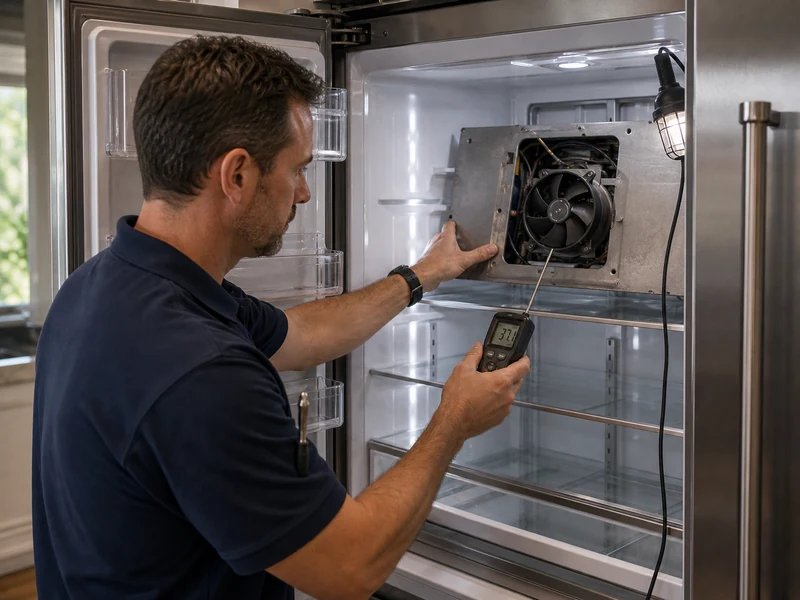
A noisy Sub-Zero is rarely a dying one. The trick is naming the source — a fan,
a relay, or the compressor — before naming a part, because each is a different bill.
When a Sub-Zero® gets loud in Fleming Island, Pace Island, or Orange Park, the noise almost
always traces to one of four sources: a fan blade ticking frost or a stiff fan bearing, a
compressor start relay clicking on a hard start, or the ice-maker fill valve buzzing as it
refills. Fans and relays run $300 to $650, ice-maker valves $250 to $700, and a failing
compressor — the rare expensive case — $1,000 to $3,000. We isolate the source
before quoting.
For Sub-Zero repair across Fleming Island, Pace Island and the Orange Park riverfront, call (904) 892-7163 or Book online.
Sub-Zero Fleming Island · Fleming Island, FL 32003 · (904) 892-7163
· online booking available · Updated June 13, 2026
Up front
Straight answers about the noise
Who diagnoses a noisy Sub-Zero in Fleming Island?
Sub-Zero Fleming Island tracks down Sub-Zero noises across Fleming Island 32003,
Pace Island, Eagle Harbor, and Orange Park, with phone booking at
(904) 892-7163 and an external online
scheduling page. The job starts with a stethoscope, not a parts catalog — we find where
the sound lives before anything is replaced.
Why does isolating the noise matter so much?
Because the four common sources sit in four different cost lanes. A fan and a relay are cheap;
an ice-maker valve is moderate; the compressor is the expensive outlier. Guessing from the
symptom alone is how a $300 fan job gets misquoted as a $2,000 compressor. We separate them by
where the noise comes from and what it does across a cooling cycle.
Is a noisy Sub-Zero an emergency?
Usually not. A light fan tick or a periodic ice-maker buzz can wait for a convenient
appointment. A hard, repeating click with the compressor failing to start, or a grinding
bearing, should be seen sooner — and if the cabinet is also warming, it becomes a
not-cooling call to book the same day.
One call, one tech, straight answers.
Cause · evidence · cost
Where a Sub-Zero noise comes from
Four sources cover nearly every noise call. Each has a distinct sound and a distinct location,
and each lands in its own lane.
A scheduled buzz that tracks ice-making usually belongs on the
ice maker page, and any noise that arrives with a warming
cabinet is mapped on the not-cooling page.
Diagnosis
The diagnostic sequence for a noisy unit
Cheapest and most likely source first. This is the order we run on a Clay County noise call,
before any part is named.
- Locate the noise — upper interior, low behind the grille, or at the ice maker — and note whether it tracks the door, the fan, or the ice cycle.
- Check the evaporator fan for a blade ticking frost or debris, and for a bearing that has stiffened.
- Pull the kick grille and check the condenser fan for the same, cleaning the coil while it is open.
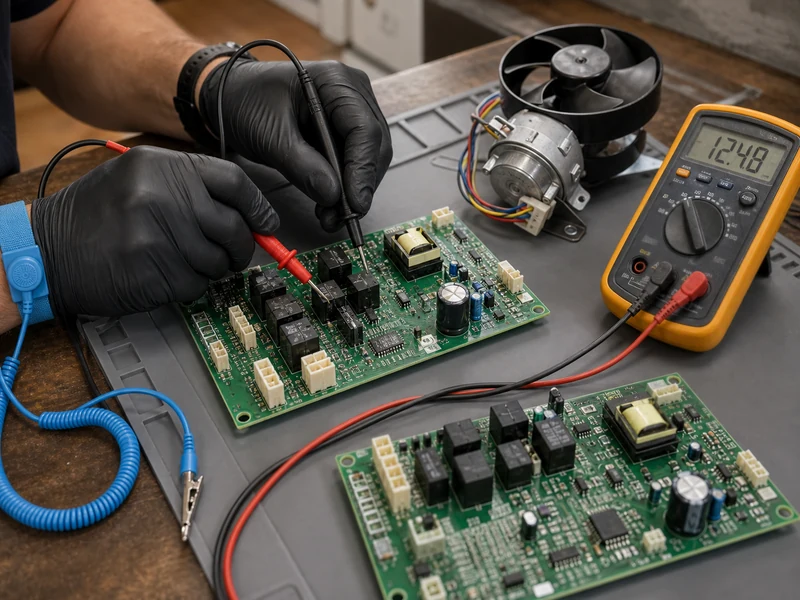
- Listen for the hard-start signature — a click with a hum that drops out — and meter the start relay before suspecting the compressor.
- If the buzz is scheduled, check the ice-maker fill valve, which scales and sings on Clay County hard water.
- Only with fans, relay, and valve cleared do we evaluate the compressor itself, and quote in writing.
Telling them apart
Fan, relay, or compressor? How the sounds split
The fear with a loud Sub-Zero is always the compressor, but the cheap sources and the expensive
one make different sounds in different places. This is how we separate them before a number is
quoted.
The single most useful tell is the click-with-a-dropout-hum: that is the relay, not the
compressor, and the relay is replaced first every time.
Facts that travel
Noise numbers worth keeping
- Four sources: fan, relay, ice-maker valve, or compressor — almost every noise call is one of these.
- Location names the part: upper interior is the evaporator fan, low behind the grille is the condenser fan or compressor.
- Click + dropout hum: the hard-start relay signature — the cheap part, replaced before the compressor.
- Scheduled buzz: a noise that tracks the ice cycle is the fill valve, loud on Clay County's hard water.
- $300–$650: the lane most fan and relay noise repairs fall into once the source is isolated.
Local notes
Why Clay County units get noisy
Two local realities shape the noise calls we run. The first is the housing cohort. Pace Island
and Eagle Harbor filled in from the late 1980s through the 2000s, and the Orange Park riverfront
estates run older still, so many waterfront kitchens hold 600-series and early built-in units
now decades into service. Fan-motor bearings stiffen and start relays weaken with the years, and
a vintage unit that has developed a new hum or click is usually telling you a bearing is drying
out or a relay is tiring — both routine, both far cheaper than the compressor owners fear.
The second is the water. Clay County Utility Authority water runs hard, in the metro's 14-to-28
grains-per-gallon range, and that scale narrows ice-maker fill valves and tubes until they sing
on every refill. A scheduled buzz that tracks ice-making is one of our signature local calls,
and it is a descale-or-replace job on the ice maker, not a fan
or compressor problem at all.
Case notes
Diagnostic case notes from the route
These are educational diagnostic scenarios, not customer reviews — composites drawn from
the noise calls we handle in Clay County, written to show how a sound turns into a source.
Orange Park: a click every few minutes on a 600 series
A riverfront 600-series unit clicked every few minutes with a brief hum that quit each time, and
the owner feared the compressor. The signature was a textbook hard start: the start relay was
failing to bring the compressor online. A new relay quieted it on the spot, and the compressor
itself tested healthy — a routine ticket, not the four-figure repair the noise suggested.
Pace Island: a buzz on a schedule
A waterfront over-under buzzed for a few seconds every couple of hours, always around ice-making.
The ice-maker fill valve had scaled on Clay County hard water and sang each time it opened. A
descale and valve service cleared the noise, and a filter change kept it from coming back —
no fan, no relay, no compressor involved.
Questions
Fleming Island noise questions
My Sub-Zero is making a loud buzzing noise. Is that dangerous?
Usually it is annoying rather than dangerous, but it is worth diagnosing because the cause sits in very different cost lanes. A steady buzz or hum is often an evaporator or condenser fan blade ticking against light frost or a fan with a stiffening bearing. A sharper electrical buzz paired with a click can be the compressor start relay struggling. We isolate the noise to a fan, a relay, or the compressor before naming a part, because guessing turns a cheap fix into an expensive one.
What is the clicking noise my Sub-Zero makes every few minutes?
A short click that repeats every few minutes, sometimes with a brief hum that quits, is the classic hard-start signature: the compressor start relay is trying to bring the compressor online and dropping out when it cannot. The relay is the cheap part in that story and is replaced first. Only if a new relay does not hold does the diagnosis move toward the compressor itself, which is a different lane entirely.
Where is the noise coming from — how do you tell?
By location and by the sound's character. A noise from the upper interior that changes when you open the fresh-food door points to the evaporator fan. A noise from down low behind the kick grille points to the condenser fan or the compressor. A rhythmic tick that speeds with the fan is a blade hitting frost or debris; a hard electrical click is a relay; a deep continuous drone that never varies is the compressor. We listen at each location and watch what the noise does across a cycle before we open anything.
Could the buzzing just be the ice maker?
Often, yes, and it is the most benign source. A short buzz or hum on a schedule — every couple of hours — is usually the ice maker water-fill valve opening to refill the mold, especially loud on Clay County's hard water where scale narrows the valve and makes it sing. If the noise tracks the ice-making cycle and the unit is otherwise fine, it points to the fill valve, which is its own descale-or-replace job rather than a fan or compressor problem.
How much does fixing a noisy Sub-Zero cost?
It depends entirely on the source, which is why isolating it first matters. A fan motor or blade and a condenser cleaning typically run $300 to $650. A start relay is on the lower end of that range. An ice-maker fill valve or descale lands around $250 to $700. A failing compressor is the expensive outlier at $1,000 to $3,000, and we never name it until the relay and the fans are ruled out with a meter and a stethoscope.
The noise is worse on my older Sub-Zero. Is age the cause?
Age loads the dice toward bearings and relays. Many Pace Island and Orange Park kitchens still run 600-series and early built-in units now decades old, and fan-motor bearings stiffen and start relays weaken with the years. A vintage unit that has developed a new hum or click is most often telling you a fan bearing is drying out or a relay is tiring — both routine, both far cheaper than the compressor that owners fear.
Can I keep running the unit while it is noisy?
For a short window, usually yes, but read the noise. A light fan tick or a periodic ice-maker buzz is not urgent — book it at your convenience. A hard click that repeats with the compressor failing to start, or a fan that is grinding rather than ticking, should be seen sooner, because a struggling relay stresses the compressor and a grinding bearing can seize. If the cabinet is also warming, treat it as a not-cooling call and book the same day.
All service
More Sub-Zero help in Clay County
Get on this week's route
Tell us the model and the symptom, and we'll bring the likely parts on the first visit —
Fleming Island to the Orange Park riverfront.
(904) 892-7163 — Monday–Friday, 8:00 am–6:00 pm