Not cooling
Sub-Zero Not Cooling on Fleming Island
A warm Sub-Zero rarely means a dead one. Most of the time it is airflow, a sensor, or a
surge-locked board — cheaper to fix than the worst-case people assume.
When a Sub-Zero® stops cooling around Fleming Island, Pace Island, or Orange Park, the
usual causes are a clogged condenser, a failed evaporator fan, a drifting thermistor, or a
board locked by a storm-season surge. Those repairs run $250 to $1,100. A true sealed-system
leak is rarer and quoted only with pressure evidence.
For Sub-Zero repair across Fleming Island, Pace Island and the Orange Park riverfront, call (904) 892-7163 or Book online.
Sub-Zero Fleming Island · Fleming Island, FL 32003 · (904) 892-7163
· online booking available · Updated June 13, 2026
Up front
Straight answers when nothing is cold
Who repairs a Sub-Zero that stopped cooling in Fleming Island?
Sub-Zero Fleming Island diagnoses and repairs Sub-Zero cooling failures across Fleming Island
32003, Pace Island, Eagle Harbor, and Orange Park, with phone booking at
(904) 892-7163 and an external online
scheduling page. We are the shop that keeps Clay County on the route, not on the waiting list.
What does a not-cooling diagnosis cost?
A service visit puts a tech in front of the unit to find why it warmed, document the fault,
and hand you a firm repair number before any part goes in. Most cooling repairs land between
$250 and $1,100, and the diagnosis fee rolls into the job once you approve it.
What if the compressor or sealed system is suspected?
That work is real but uncommon. We only put a sealed-system or compressor quote — the
$1,500-and-up range — in writing after airflow, electrical, and pressure readings rule
out the cheaper causes. You should never pay for a guess on the most expensive repair a
Sub-Zero can need.
One call, one tech, straight answers.
Before you call
Safe checks worth doing first
A handful of these you can run yourself in five minutes, and they sometimes save a service
call entirely. None of them involve opening a sealed system or touching wiring.
- Confirm the unit has power — check the outlet behind the kick grille and the breaker, since a surge can trip one without anything else looking wrong.
- Verify the set points still read 38°F fridge and 0°F freezer; a bumped dial or touch panel is a real cause.
- Feel the condenser airflow at the grille. If it is choked with dust, pollen, or pet hair, that alone can warm the box.
- Listen for the compressor and fans. Dead silence with interior lights on usually means a locked or failed board, not a dead compressor.
- Check the doors close flush and the gaskets are not propped open by a shelf or a package.
One thing to leave alone: if the unit is silent with a blank panel after an
outage, you can try one controlled power-down (breaker off two minutes, then on). Beyond
that, surge-locked board work is a tech job — repeated power cycling will not revive a
board the surge already corrupted.
Diagnosis
Why is my Sub-Zero not cooling?
A Sub-Zero holds temperature with a sealed refrigeration loop, fans that move the cold air,
sensors that meter it, and a control board that runs the show. A warm cabinet means one of
those links quit. This is the symptom map we work from on a Clay County call.
A warm fridge with a working freezer almost always belongs on the
refrigerator repair page, and a blank built-in panel is
covered in detail on the BI series page. If the panel is
flashing an EC50 or EC40 code, or the warm-up
followed a storm or power outage, those
pages walk the specific path.
Evidence · reading · decision
How we rule cheap out before expensive
The order is the whole point. We exhaust the free and low-cost causes before anyone talks
about a board or a sealed system, so the number you hear is the real one, not a default.
That last line is not us ducking work — a unit under factory coverage should use it,
and we will say so when you call. Once warranty ends, we are right here.
On arrival
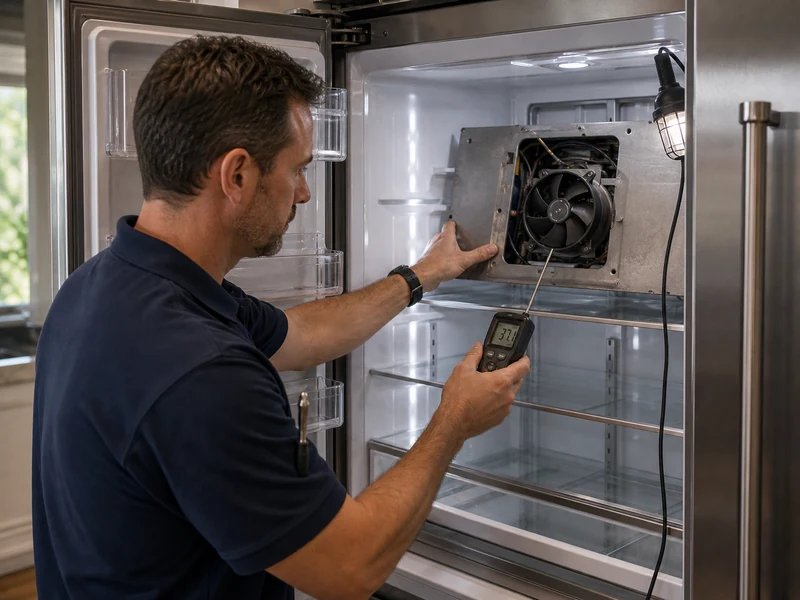
What a tech does in the first fifteen minutes
A warm-cabinet diagnosis follows a fixed order, because the cheapest causes hide the
expensive ones if you skip them. This is the sequence on a Clay County not-cooling call,
before any part is ever named.
- Read the live panel and any error code, then confirm the unit has power at the outlet and breaker.
- Pull the kick grille and inspect the condenser; a coil packed with lake-air dust mimics half a dozen faults.
- Probe the fresh-food and freezer air temperatures against the 38°F and 0°F targets.
- Listen for the compressor and the evaporator fan, and check the door seals for a bleed.
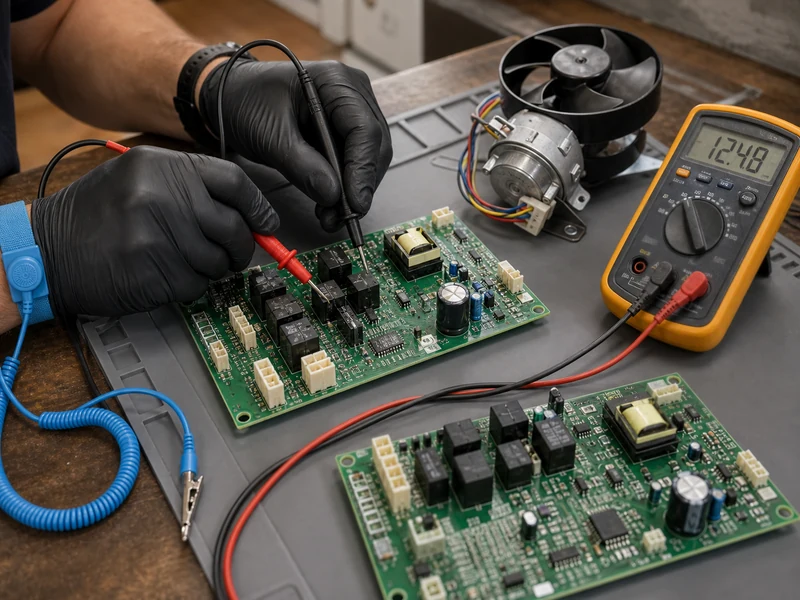
- Only then meter the thermistors, board, and — if the evidence calls for it — the sealed-system pressure.
Telling them apart
Cheap cause or expensive one? How the symptoms split
The fear with a warm Sub-Zero is always the sealed system, but the routine causes and the
expensive one leave different fingerprints. This is how we separate them before a number is
ever quoted.
A blank panel after a flicker is its own story on the
BI series page, and the double-dash board fault belongs on
the 600 series page.
Facts that travel
Not-cooling numbers worth keeping
- 38°F / 0°F: the target temperatures a healthy Sub-Zero holds — a warmer fridge alone is airflow, not refrigerant.
- 9 in 10: not-cooling calls that turn out to be a coil, fan, sensor, or board rather than the compressor.
- $250–$1,100: the lane most Clay County cooling repairs fall into once diagnosed.
- 24 hours: the time a Sub-Zero needs to stabilize after a repair before its temperatures mean anything.
- A few inches of frost: a short, partial band on the evaporator is the visual tell of a sealed-system leak.
Local notes
Why Clay County units go warm
Two local realities drive most of these calls. The first is the lake. Pace Island and Eagle
Harbor sit on Doctors Lake, and waterfront air keeps those kitchens humid through every
season, so condensers load with dust and pollen faster than the manual assumes. A coil nobody
has cleaned in years is the quiet head start behind a lot of warm-cabinet complaints.
The second is lightning. Clay County sits under more than a hundred storm days a year,
and the surge when utility power snaps back after an outage is the documented killer of
Sub-Zero control boards. We saw it in waves after Matthew in 2016 and Irma in 2017, and we
see a few locked panels every storm season since. A blank panel after a flicker is a routine
call for us — and a reason we suggest whole-home surge protection in the
lakefront care guide.
Case notes
Diagnostic case notes from the route
These are educational diagnostic scenarios drawn from the kind of not-cooling calls we handle
in Clay County — composites, not individual customers — written to show how a
warm cabinet turns into a fix.
Pace Island: warm box, full bin of ice
A waterfront over-under had a fridge creeping toward 50°F while the freezer still made
ice. The compressor and freezer ran fine; the evaporator fan that pushes cold up to the
fresh-food side had seized. A fan motor and a quick condenser clean brought it back, and the
24-hour recheck confirmed a steady 38°F — no sealed-system work, no new unit.
Eagle Harbor: dark panel after a summer storm
A BI built-in went silent during a July outage and never came back, lights on but panel
blank. A controlled power-down did not revive it; voltage at the board was present, but the
board itself was locked by the restoration surge. A replacement board returned full control,
and the owner added a whole-home surge device before the next storm season.
Questions
Fleming Island not-cooling questions
My Sub-Zero quit cooling right after a Clay County power flicker. What now?
Give it an hour before you panic. A short outage sometimes leaves a BI board in a locked state — lights on, panel dark — that a controlled power-down can clear. Unplug it or trip its breaker for two minutes, restore power, and watch the panel. If it stays dark or the cabinet keeps warming, the board likely took a surge hit and needs replacing.
Should I move my food out while I wait for a tech?
Use judgment by temperature, not the clock. A closed Sub-Zero holds cold for hours, so if the fridge still reads under 40°F, leave the door shut and ride it out. If the freezer has climbed above 0°F and softened, move the freezer items first — they represent the bigger loss — into a cooler or a neighbor’s unit until we arrive.
Is a warm Sub-Zero always an expensive repair?
No, and that is the most common misread. A dirty condenser, a tired evaporator fan, or a drifting thermistor warms a cabinet and costs $250 to $650 to fix. A locked board runs higher but is still routine. The genuinely expensive path — a sealed-system leak — is the minority of calls, and we never quote it without pressure evidence.
How do you tell a sensor problem from a real refrigerant leak?
The frost pattern and the readings. A healthy unit frosts its evaporator coil evenly; a short, partial band of frost — only a few inches — points to a refrigerant leak in the sealed system. We pair that visual with air-temperature probes, electrical checks, and a pressure read before we put any sealed-system number in writing.
Can I keep using my Sub-Zero while it is running warm?
For a day or two of light use, often yes, but it depends on the fault. If the compressor is running constantly and never satisfying, you are stressing it and running up the power bill, so sooner service is smarter. If the unit is dead silent with a blank panel, leave it off the food rotation and book a diagnosis before contents spoil.
Only my fridge is warm and the freezer is rock solid. Does that narrow it down?
Sharply. A warm fresh-food box with a healthy freezer means the refrigeration itself is working and the cold simply is not reaching the upper cabinet, so the suspects are the evaporator fan, a stuck air damper, or a drifting thermistor. It is almost never the compressor or a refrigerant leak in that pattern. Those repairs land in the $250 to $650 lane, and the full breakdown is on the refrigerator repair page.
Everything went warm at once, both sides. Is that worse than a one-side failure?
It points to a shared cause rather than a doomed unit. Both sides warming together usually means a clogged condenser shedding no heat, a control board that has dropped out, or, least often, a sealed-system loss feeding both circuits. We start at the condenser and the board because those are the cheap, common answers; the sealed system is only named after a pressure read. A whole-cabinet warm-up is no more likely to be terminal than a one-side fault.
How quickly should I act before food becomes a safety question?
Use the four-hour rule as a guide. A closed Sub-Zero holds cold well, but once the fresh-food side climbs above 40 degrees, perishables enter the risk zone within about four hours, and a freezer that has fully softened should be treated as thawed. Keep the doors shut, move the freezer items first since they are the larger loss, and book the diagnosis the same day if the cabinet is climbing rather than holding.
All service
More Sub-Zero help in Clay County
Get on this week's route
Tell us the model and the symptom, and we'll bring the likely parts on the first visit —
Fleming Island to the Orange Park riverfront.
(904) 892-7163 — Monday–Friday, 8:00 am–6:00 pm