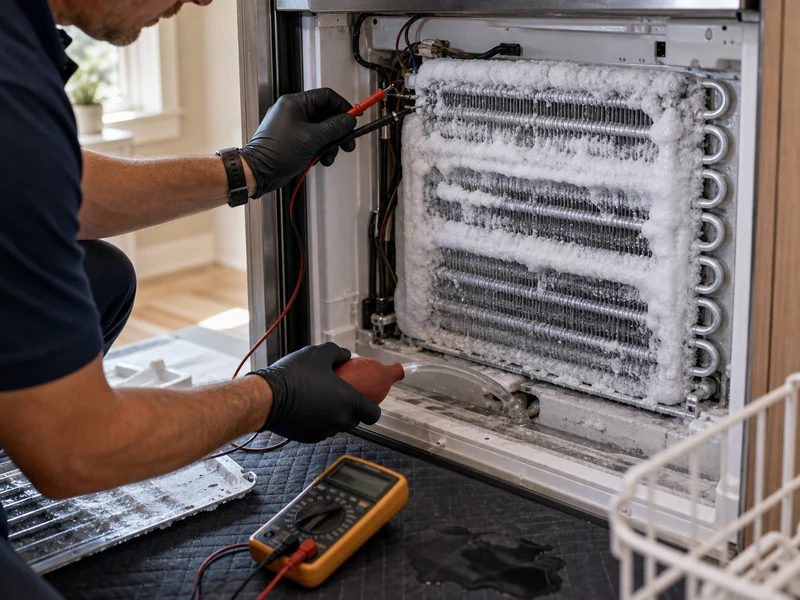
Leaking water
Sub-Zero Leaking Water in Orange Park
A puddle under the cabinet or an ice slab under the basket points the same direction —
a defrost drain that iced shut — long before anything in the sealed system is to blame.
A Sub-Zero® leaking water around Orange Park, Fleming Island, or Pace Island is almost
always a clogged defrost drain: meltwater backs up, refreezes, then spills onto the floor.
The next suspect is a weeping ice-maker inlet valve. Drain-clearing and valve repairs run
$250 to $600, diagnosed before any part goes in.
For Sub-Zero repair across Fleming Island, Pace Island and the Orange Park riverfront, call (904) 892-7163 or Book online.
Sub-Zero Fleming Island · Fleming Island, FL 32003 · (904) 892-7163
· online booking available · Updated June 13, 2026
Up front
The short story on a leaking Sub-Zero
Every Sub-Zero makes water on purpose. The defrost cycle melts frost off the freezer coil
several times a day, and that meltwater is supposed to run down a small channel into a pan
where it evaporates. When the channel ices over, the water has nowhere to go — so it
refreezes inside or escapes to the floor. The other water source is the ice-maker supply
line. Almost every leak we see is one of those two, and neither requires sealed-system work.
What is the defrost drain? The channel and tube that carry meltwater from
the freezer evaporator down to an evaporation pan near the compressor. A few thousand defrost
cycles of debris and mineral film, plus the odd ice plug, are enough to block it on an older
unit.
One call, one tech, straight answers.
Diagnosis
Where is the water coming from?
Location, timing, and whether it is water or ice tell us most of the story before a panel
comes off. This is the symptom map we use on a Clay County leak call.
That bottom row crosses over with both
defrost and freezer work and a broader
not-cooling diagnosis, since a buried evaporator
can leak and warm at the same time.
Source · evidence · decision
Defrost drain or water supply?
The fix depends entirely on which water is leaking. We separate defrost meltwater from supply
water first, because they live in different parts of the cabinet.
On arrival
What a tech does on a leak call, step by step
A leak is a tracing job. We separate defrost meltwater from supply water first, then follow
the offending water back to its source, so the fix addresses the cause rather than the
puddle. This is the order on a Clay County leak visit.
- Confirm where the water sits — floor, freezer floor, or fresh-food floor — and whether it is water or ice.
- Rule the supply side in or out by checking the filter housing, the dispenser, and the inlet valve for clean drips.
- Pull the rear interior panel and trace the defrost drain channel down toward the evaporation pan.
- Clear any ice plug or mineral film, warm the channel, and test that meltwater reaches the pan.
- Run a cycle, verify the leak has stopped, and check the floor and cabinetry for hidden moisture.
When the leak rides along with a warming cabinet, the same evaporator is usually behind both,
which loops back to the
freezer and defrost page and the broader
not-cooling walkthrough.
The parts
The small parts behind a Sub-Zero leak
A leak almost never comes from anything in the sealed system. It comes from a handful of
inexpensive parts in the water path, and which one is wet decides the fix. This is what we
check and what each does.
The scaled, weeping valve is a hard-water story we trace in full on the
ice maker repair page.
Facts that travel
Leak facts for Clay County owners
- The drain first: a clogged defrost drain is the leading cause of both floor puddles and ice slabs.
- $250–$600: the lane most leak and drain repairs land in once diagnosed.
- 5,000+ defrost cycles: what a decades-old 500 or 600 unit has run — why oldest cabinets clog first.
- Water vs. ice: a floor puddle and an under-basket slab share one root cause — a blocked drain.
- Cheap to catch early: a single drain clearing beats the defrost or cooling repair a neglected drain causes.
Local notes
Why leaks turn up faster on the water
The Doctors Lake waterfront is the reason this fault is so common locally. Pace Island and
Eagle Harbor kitchens stay humid year-round, and every door opening drags damp air onto a
coil that sheds more meltwater than a drier climate would produce. More meltwater through a
drain that is already narrowing means it ices shut sooner. Add the age of the housing —
most of it built between the late 1980s and the 2000s — and the original units here have
logged tens of thousands of defrost cycles, so their drains are the first to clog.
The hard water adds the rest. Clay County Utility Authority supply runs hard, and mineral
film builds inside drain channels and around inlet valves, narrowing both. That is why a leak
on the supply side here often turns out to be a scaled, weeping valve rather than a burst line.
The same hardness is what stresses ice makers, which we cover on the
ice maker repair page.
Case notes
Diagnostic case notes from the route
These are educational diagnostic scenarios based on common Clay County leak calls —
composites, not individual customers — to show how a puddle gets traced to its source.
Eagle Harbor: the slow morning puddle
A waterfront over-under left a thin pool on the tile every couple of days. The freezer was
cold and the ice maker worked, which ruled out the supply line. Behind the rear panel the
defrost drain had iced into a plug, backing meltwater up until it overflowed. Clearing and
warming the drain path ended the puddle — a single visit, no parts beyond the drain work.
Orange Park riverfront: ice under the basket
An older 600 series on the River Road side built a sheet of ice across the freezer floor while
cooling normally. The defrost cycle was running; the drain was the problem, frozen from years
of mineral film and debris. We cleared it, confirmed flow to the pan, and the slab did not
return on the follow-up check.
Questions
Orange Park water leak questions
There is water pooling under my Sub-Zero. Where is it coming from?
Most often a clogged defrost drain. Meltwater from the normal defrost cycle is supposed to run down a channel to an evaporation pan; when that channel ices shut, water backs up, refreezes, and eventually spills onto the floor. The second suspect is the ice-maker fill line. We trace the drain path and the water supply before assuming anything dramatic.
Why is there ice in the bottom of my freezer, not just water?
That is the signature of a frozen defrost drain. As the drain ices over, each defrost cycle adds a little more water that refreezes into a growing slab under the bottom basket. It is the same root cause as a floor puddle — the water simply freezes inside before it can escape. Clearing and warming the drain stops both.
Could a leak be the water filter or ice maker rather than defrost?
Yes. A cracked filter housing, a loose filter, or a weeping water inlet valve drips clean supply water rather than defrost meltwater. The tell is location and timing: supply leaks track to the upper water components and run even when the freezer is fine, while defrost leaks pool low and follow the cycle. We check both lines.
Is a leaking Sub-Zero an emergency?
It is worth prompt attention, less for the appliance than for your floor. Slow drips under a built-in can reach cabinetry and subfloor before you notice, and on the Doctors Lake waterfront that moisture invites bigger trouble. The repair itself is usually inexpensive — a drain clear or a valve — so there is little reason to let it run.
Can I just keep wiping it up until it gets bad?
You can, but the cause keeps building. A drain that is icing over only ices further, and the slab under the basket grows until it crowds the evaporator and the freezer loses cold. Wiping treats the symptom while the fault advances. A single drain-clearing visit is far cheaper than the defrost or cooling repair a neglected drain leads to.
The water seems to appear only after the unit cycles, not constantly. What does that timing tell you?
Timing is one of our best clues. Water that shows up in pulses, an hour or two apart, tracks the defrost cycle, which runs several times a day and sends meltwater down the drain each time. A clogged drain overflows on that same rhythm. Supply leaks, by contrast, drip steadily or whenever the dispenser runs. We ask you to note when the puddle grows, because the schedule separates a defrost drain from the water line before we open anything.
Why does my floor leak seem worse in summer on Doctors Lake?
More humidity means more meltwater. Every door opening in a damp waterfront kitchen drags moist air onto the freezer coil, so the defrost cycle has more frost to shed and the drain carries more water. A channel that is already narrowing with mineral film ices shut faster under that extra load, which is why a borderline drain that coped through the winter overflows once the Clay County summer sets in.
Could a leak inside the fresh-food compartment be a separate problem from a floor puddle?
Often, yes. Water collecting on the floor of the refrigerator section usually traces to a blocked upper drain port behind the rear wall, or to a door seal letting humid air condense inside, rather than the lower freezer drain that causes a floor puddle. They can coexist on an older unit, but the fix differs: an upper-port clearing or a gasket versus a freezer-side drain clear. We check both ports so one repair does not leave the other leaking.
All service
More Sub-Zero help in Clay County
Get on this week's route
Tell us the model and the symptom, and we'll bring the likely parts on the first visit —
Fleming Island to the Orange Park riverfront.
(904) 892-7163 — Monday–Friday, 8:00 am–6:00 pm