Pace Island
Sub-Zero Ice Maker Repair in Pace Island
In the gated streets off Doctors Lake Drive, weak or cloudy ice almost always comes back to
one thing — hard-water scale in the fill path — on units that have run two decades.
In Pace Island, the gated Doctors Lake community on Fleming Island, most Sub-Zero®
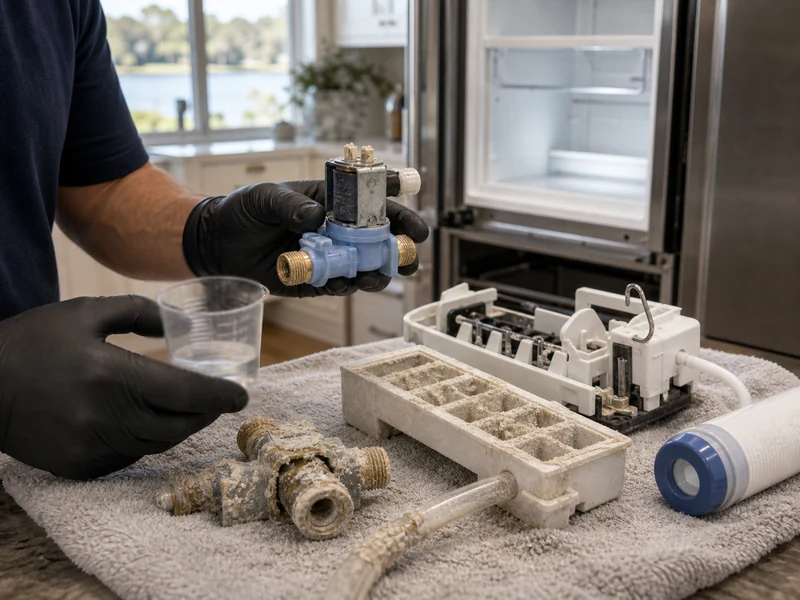
ice-maker calls trace to hard-water scale choking the inlet valve and fill tube on units built
into 1990s and 2000s kitchens. Descaling, valve, and filter repairs run $250 to $700, and we
clear the community gate at booking.
For Sub-Zero repair across Fleming Island, Pace Island and the Orange Park riverfront, call (904) 892-7163 or Book online.
Sub-Zero Fleming Island · Fleming Island, FL 32003 · (904) 892-7163
· online booking available · Updated June 13, 2026
Up front
Why Pace Island ice makers quit
Who repairs Sub-Zero ice makers in Pace Island?
Sub-Zero Fleming Island services Sub-Zero ice makers throughout Pace Island and the wider Fleming
Island 32003 waterfront, with phone booking at
(904) 892-7163 and an external online
scheduling page. We clear the community gate before the visit so nothing stalls on Doctors
Lake Drive.
What is the most common cause here?
Scale. Clay County water is hard, and on the older units common in Pace Island, mineral
buildup in the fill tube and inlet valve is the leading reason for shrinking cubes and slow
production. The water filter is the close runner-up, and both are inexpensive to address once
ruled in.
What does a Pace Island repair run?
A descale, a fresh filter, or a water inlet valve usually lands between $250 and $700,
diagnosed before any part is ordered. A full ice-maker module sits at the top of that range,
and we only go there once the cheaper links in the fill chain test clean.
One call, one tech, straight answers.
Diagnosis
Reading a struggling ice maker on Doctors Lake
Ice making is a chain — water in through the filter and valve, into the mold, frozen,
then harvested. On Pace Island water, the weak links cluster at the front of that chain. This
is the symptom map we work from on a neighborhood call.
The general version of this fault, with the full fill-path breakdown, lives on the
ice maker repair page; built-in inlet valves are covered on
the BI series page.
Access · evidence · decision
Descale, valve, or module on an older unit?
Replacing a whole assembly is the expensive default. On Pace Island’s older units we
work up the fill chain instead and only escalate when the evidence backs it.
On the visit
What a gate-cleared Pace Island call looks like
Once the gate is arranged at booking, the visit itself follows the water path from the wall
to the mold, so the cheap, common scale faults surface before anyone touches the module. This
is the order on a Doctors Lake ice-maker call.
- Clear the community gate or guard at the entrance using the access notes you gave at booking.
- Check the filter age and the supply shutoff, then confirm water actually reaches the unit.
- Measure the fill volume into the mold — a partial fill is the scale fingerprint on Pace Island water.
- Descale the fill tube and inlet valve, test the solenoid, and flush the line until it runs clear of grit.
- Verify the module cycles and harvests, then confirm the first cube batch before closing the ticket.
The general fill-path breakdown sits on the
ice maker repair page, and the wider waterfront access detail
on the Pace Island and Eagle Harbor coverage page.
Facts that travel
Pace Island ice facts worth saving
- 14–28 grains per gallon: the metro hardness range — among the highest in Florida, straight off the limestone aquifer.
- Late 1980s–2000s: when most Pace Island homes were built, so original ice makers have run decades on hard water.
- ~6 months: Sub-Zero’s filter interval; on this water, sooner is often smarter.
- $250–$700: the lane most ice-maker repairs land in once diagnosed.
- Gate cleared first: we arrange Pace Island community access at booking, not at the call box.
Local notes
What makes Pace Island its own case
Pace Island sits gated on Doctors Lake, and the setting shapes the work. The community went up
largely between the late 1980s and the 2000s, so the Sub-Zero units here are mostly 600 series
and early BI built-ins whose ice makers have spent twenty-plus years on Clay County’s
hard water. That is a long time for scale to plate out inside fill tubes and inlet valves,
which is exactly why so many calls start as "the ice keeps getting smaller."
Lake humidity stacks on top. Waterfront kitchens run damp year-round, and homes with
undercounter UC-15I machines in butler pantries or summer kitchens see their condensers clog
faster in the moist, tight cabinetry — another drag on production layered over the scale.
Because the neighborhood is gated, the practical detail that actually saves your morning is
access: we clear the gate at booking so the tech reaches the kitchen, not the entrance. Street
and access notes for the whole waterfront sit on the
Pace Island and Eagle Harbor page.
Case notes
Diagnostic case notes from Pace Island
These are educational diagnostic scenarios drawn from the kind of ice-maker calls we handle in
this neighborhood — composites, not individual customers — to show how a weak bin
gets sorted.
Doctors Lake Drive: the shrinking cube
A 600 series in a 1990s waterfront kitchen had dropped to a thin layer of half-formed cubes a
day. The module cycled fine; the fill tube and inlet valve were scaled nearly shut. A descale,
a new valve, and a fresh filter brought the harvest back to a full bin — no module, no
drama, one gate-cleared visit.
Pace Island pantry: the cloudy undercounter
An undercounter ice machine in a butler pantry produced soft, cloudy ice that tasted flat. The
filter was long past due and the condenser had clogged in the close cabinetry. We descaled the
system, cleared the condenser, and replaced the cartridge; the next batch came out clear and
the production rate recovered.
Questions
Pace Island ice maker questions
Why do Pace Island ice makers seem to fail more than most?
Two reasons that overlap on the lake. Clay County Utility Authority water is hard, so scale builds in the fill path and chokes production. And many Pace Island homes date from the late 1980s through the 2000s, so the original ice makers have run on that hard water for two decades. The combination is why "small cubes" is one of our most common neighborhood calls.
Do you clear the Pace Island gate before you arrive?
Yes. Pace Island is gated, and we handle the access arrangement when you book so the visit is not stalled at the call box. Give us the gate or community instructions at scheduling along with the model and symptom, and the tech rolls straight to the kitchen instead of waiting at the entrance on Doctors Lake Drive.
My Pace Island home is on the older side. Are ice-maker parts still available?
For most local units, yes. The 600 series and early BI built-ins common in Pace Island still have inlet valves, fill tubes, and modules available, and we carry the parts these units fail on most. A genuinely scarce part we source and quote before ordering, and we price a rebuilt option where one exists rather than push a whole new assembly.
Is my cloudy Pace Island ice a water problem or an ice-maker problem?
Usually the water and the filter, not the machine. Hard water plus a filter past its service life passes more mineral content and odor into the bin, turning cubes cloudy and flat. We swap the cartridge, flush the line, and confirm the ice clears before touching the module. It is the cheapest fix in the lineup and the first one we rule out.
Will a softener or filter upgrade keep the ice maker healthy longer?
It helps. On water this hard, a fresh filter on schedule and, where a home has one, a working softener slow the scale that strangles inlet valves and fill tubes. We cannot install whole-home water treatment, but we will tell you honestly whether scale is your recurring issue and lay out the maintenance rhythm that keeps a Pace Island ice maker producing.
I have a built-in ice maker and a separate undercounter machine in the Pace Island pantry. Can both be sorted in one gate-cleared trip?
Yes, and that is the efficient way to do it on a gated visit. Larger Pace Island homes on Doctors Lake commonly run a BI built-in ice maker plus a UC-15I undercounter machine in a butler pantry, and both scale on the same hard water. We clear the community gate once, bring fill valves and descale supplies for both, and check the undercounter condenser while we are there, since the tight pantry cabinetry clogs it fast in lake humidity.
My Pace Island ice tastes fine but the cubes come out hollow and small. Is that still scale?
Almost certainly. Hollow, undersized cubes are the classic partial-fill signature: scale has narrowed the fill tube or crusted the inlet valve so the mold only half fills before the harvest cycle fires. The taste stays acceptable because the filter is still doing its job, but the volume drops. A descale of the fill path and, if the solenoid sticks under test, a new valve restores full cubes — usually in the $250 to $500 lane.
How fast can you reach a Pace Island address once I have cleared the gate at booking?
Because we run standing Clay County routes through the Doctors Lake waterfront, a Pace Island call does not wait behind a queue of mainland jobs. We schedule within the week and arrange the gate or guard clearance at booking, so the tech rolls straight to the kitchen off Doctors Lake Drive rather than idling at the call box. Tell us at scheduling if the bin is fully empty and we will weigh the urgency.
All service
More Sub-Zero help in Clay County
Get on this week's route
Tell us the model and the symptom, and we'll bring the likely parts on the first visit —
Fleming Island to the Orange Park riverfront.
(904) 892-7163 — Monday–Friday, 8:00 am–6:00 pm